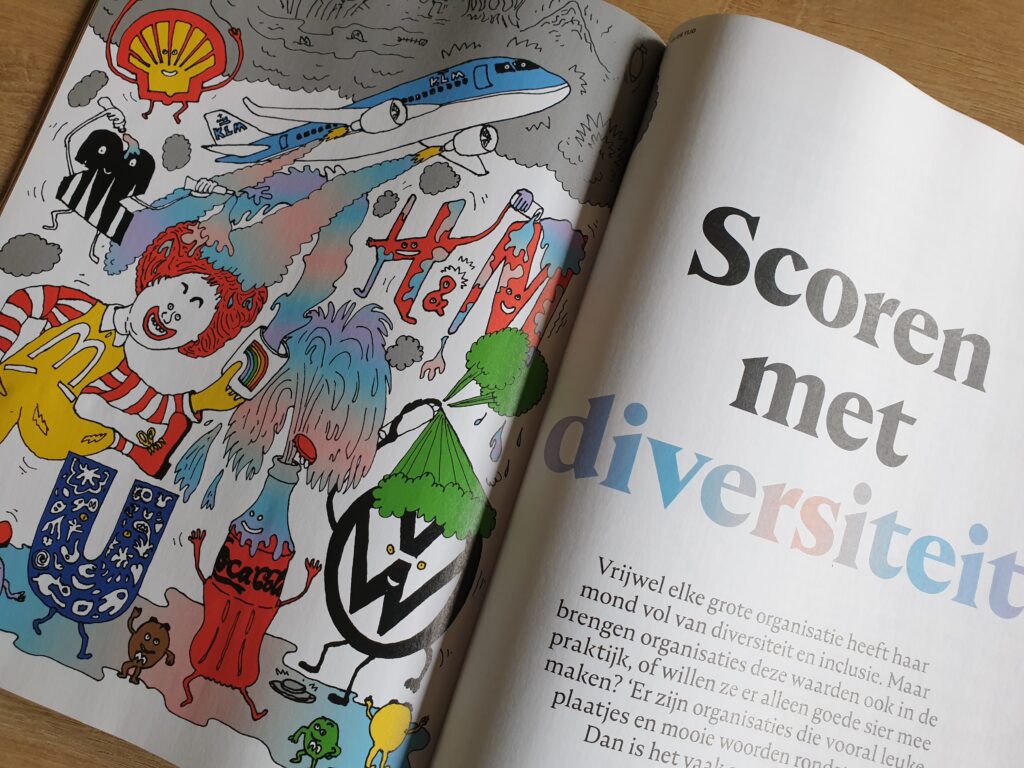
Comments Off on Interview on colorwashing in HP/De Tijd
This month, the magazine HP/De Tijd focuses on my recent research into ‘colorwashing’ – the tendency of organizations to communicate positively about diversity, with the aim of improving reputation, without correlation with actual or intended diversity activities.
Comments Off on Starting New Position at Amsterdam School of International Business
Starting Sept 1st, I will be working as Associate Professor at the Amsterdam School of International Business (AMSIB), of Amsterdam University of Applied Sciences. I’m looking forward to meeting AMSIB’s international students and staff, and working together on teaching and research projects.
Comments Off on Who benefits from the international classroom? – New Publication
Who benefits from the international classroom? A longitudinal examination of multicultural personality development during one year of international higher education Joep Hofhuis, Joran Jongerling, Jeroen Jansz
Abstract:
Purpose
Enhancing students’ intercultural competences through international higher education requires a thorough understanding of the way in which these competences develop over time, how they relate to outcomes, and which factors predict their growth. To answer these questions, a three-wave longitudinal study was conducted among a sample of first-year students in an international university program (n = 425). Intercultural competences were operationalized through the five dimensions of the Multicultural Personality Questionnaire (MPQ): Cultural Empathy, Openmindedness, Flexibility, Social Initiative and Emotional Stability. We examined development of these traits across one year, as well as their relationship with stress, life satisfaction, and academic performance (GPA). Cultural background (local vs. international student) and prior international experience (yes/no) were included as predictors. Results show that MPQ scores at the beginning of the year negatively relate to change across semester 1, which in turn is negatively related to change across semester 2. These findings suggest the presence of ceiling effects in MPQ development. In semester 1, emotional stability acts as a buffer against stress. In semester 2, stress is lower among students with higher scores on cultural empathy, and lower scores on flexibility. Cultural empathy and social initiative relate positively to academic performance. No significant main effects were found for cultural background, or prior international experience. However, these predictors interact on openmindedness and social initiative: local students with no prior international experience show a significant increase in these dimensions across the first semester, whereas the others do not.
Reference:
Hofhuis, J., Jongerling, J. & Jansz, J. (2023). Who benefits from the international classroom? A longitudinal examination of multicultural personality development during one year of international higher education. Higher Education. https://doi.org/10.1007/s10734-023-01052-6
Comments Off on NWO Open Competition XS Grant: ‘Colorwashing’ in Organizational Communication
Good news! This year I will be able to expand my research project on how organizations communicate about diversity, especially focusing on the prevalence of ‘colorwashing’, thanks to a NWO Open Competition XS Grant (https://www.nwo.nl/en/researchprogrammes/open-competition-ssh/granted-projects).
From Colorwashing to Diversity Champion: Using machine learning to examine the relationship between organizational diversity communication and diversity outcomes.
Colorwashing’ is the practice of communicating positive diversity related messages with the goal to increase an organization’s reputation, without a relation to actual or intended diversity activities. Colorwashing increases public scepticism towards diversity communication, and harms existing efforts to increase workplace inclusion. This project uses machine learning algorithms to generate datasets on the prevalence of diversity communication in social media posts and annual reports of multinational organizations, and compares them to actual diversity outcomes. This will provide new knowledge on the how and why of colorwashing in organizational communication, and how to reduce it in the future.
Comments Off on Comparing cultural diversity perspectives among public service employees in the Netherlands – New Publication
Comparing cultural diversity perspectives among public service employees in the Netherlands in 2008 and 2018 Joep Hofhuis
Abstract:
Purpose
The Netherlands’ national government
(Rijksoverheid) is an example of a large public organization that
strives to recruit and retain employees from different cultural groups,
and aims to reap the benefits of workplace diversity. Research has shown
that a major predictor of the effectiveness of diversity policy and
interventions is the diversity perspective of employees, i.e. which
outcomes they associate with cultural diversity in their work
environment.
Design/methodology/approach
The present study compares public servants’ diversity perspectives in two similar independent samples, from 2008 (n = 1,617) and 2018 (n = 2,024), using the Benefits and Threats of Diversity Scale (BTDS; Hofhuis et al., 2015).
Findings
Results show that in 2018, employees of the
Netherlands’ national government perceived more benefits of diversity
for gaining insight about and access to different groups within society.
Additionally, contributions of cultural diversity to creativity and
innovation within teams are reported significantly more often in 2018
than in 2008.
Originality/value
The findings may be of interest to diversity
scholars, since data on changes in cultural diversity perspectives
across time are rare, and the paper provides a unique comparison of
measurements at two time points, one decade apart, within the same
organization.
Comments Off on Diversity Perspectives in Annual Reports – New Publication
Automated content analysis of cultural Diversity Perspectives in Annual Reports (DivPAR): Development, validation, and future research agenda. Joep Hofhuis, Pytrik Schafraad, Damian Trilling, Nastasia Luca, & Bastiaan van Manen.
Abstract:
Objective: In this article, we present a digital tool (Diversity Perspectives in Annual Reports [DivPAR]) for automated content analysis of annual reports, designed to identify the presence of three cultural diversity perspectives-the Moral, Market, and Innovation perspectives-based on earlier work by Ely and Thomas (2001).
Method: In Study 1, we describe the development and validation of the instrument, through an iterative procedure in which manual annotation of independent subsamples (n = 24, 25) by human coders was compared to the computer coding in subsequent rounds, until sufficient agreement was reached. In Study 2, we illustrate the type of data that the script generates, by analyzing the prevalence of the three perspectives in annual reports of 55 Dutch organizations over a period of 2 decades (1999-2018; n = 937).
Results: Our findings confirm that DivPAR is sufficiently reliable for use in future research. In Study 2, we show that among Dutch organizations, the moral perspective is most prevalent, but the market and innovation perspectives are increasing in popularity.
Conclusion: DivPAR can be used to analyze the prevalence and longitudinal development of diversity perspectives in organizational communication. It enables scholars to draw comparisons across different sectors, regions, or countries, to study how diversity perspectives correlate with societal developments, and to uncover the (lack of) relationships between diversity communication and diversity outcomes. Directions for future research are discussed at the end of the article.
Hofhuis, J., Schafraad, P., Trilling, D., Luca, N., & van Manen, B. (2021). Automated content analysis of cultural Diversity Perspectives in Annual Reports (DivPAR): Development, validation, and future research agenda. Cultural Diversity and Ethnic Minority Psychology. Advance online publication. https://doi.org/10.1037/cdp0000413
Comments Off on Multicultural personality predicts effectiveness in intercultural simulation game – New Open Access Publication
Multicultural personality and effectiveness in an intercultural training simulation: The role of stress and pro‐active communication. Joep Hofhuis, Marike F. Schilderman, & Arjan Verdooren.
Abstract:
Multicultural personality traits have been shown to predict intercultural outcomes in a range of settings. However, how these traits affect behaviour during intercultural interactions remains an understudied area. A study was conducted among participants in intercultural training sessions, to examine whether scores on the five dimensions of the Multicultural Personality Questionnaire (MPQ) could predict how they performed in the intercultural simulation game “Barnga.” Both a self‐rating and other‐rating of intercultural effectiveness were included. Furthermore, we examined whether perceived stress and pro‐active communication played a mediating role. Results of Latent Growth Curve Modelling (LGCM) show that emotional stability has a positive effect on mean scores (intercept) of both self‐rated and other‐rated outcomes, mediated through perceived stress. Social Initiative has a positive effect on the rate of improvement (slope) in other‐rated outcomes during the simulation, mediated through pro‐active communication.
Comments Off on Diversity workshops at the municipality of Gouda
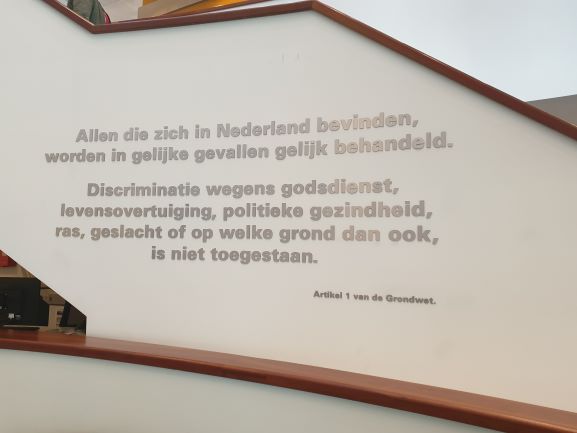
Article 1 (non-discrimination clause) of the constitution of the Netherlands is prominently displayed at the entrance of the city hall of Gouda, where I just completed a series of workshops with managers and employees, about diversity management and how to deal with differences in the workplace.
Comments Off on Government employees perceive more benefits of diversity in the workplace – New Open Access Publication
Development of diversity perspectives in the Netherlands’ Public Service in the period 2008-2018 Joep Hofhuis & Anouk van Drunen.
The success of diversity management is dependent on how employees experience cultural diversity in their daily work. In 2008, Joep Hofhuis examined these diversity perspectives among employees of the Netherlands’ public service. In 2018, the Ministry of Internal Affairs and Kingdom Relations (BZK) asked him to continue this study to find out how the perspectives have changed over the past ten years.
A digital survey was distributed among government employees, asking which positive and negative outcomes of cultural diversity they experience in their workplace. A comparison was then made between answers that were given in 2008 (1617 respondents, in 7 organizations) and 2018 (2024 respondents in 14 organizations).
The results show that, in 2018, government employees experience more positive effect of cultural diversity than ten years before. Especially the added value of diversity for productivity (the business case) is recognized more. The respondents felt that diversity increased their team’s problem solving abilities, and that it helps them connect with different cultural groups in Dutch society. Additionally, compared to 2008, they also experience that diversity leads to more changes in norms and values in the workplace.
Finally, the study shows that a strong diversity climate – an organizational climate characterized by openness to diversity – may enhance positive outcomes of diversity, whereas transformational leadership – a leadership style based on inspiring and motivating employees – may reduce diversity resistance.
Hofhuis, J., & van Drunen, A. (2019). De ontwikkeling van de beeldvorming rondom culturele diversiteit bij de Rijksoverheid in de periode 2008-2018. Rotterdam: Erasmus University Rotterdam, Erasmus Research Centre for Media, Communication, and Culture (ERMeCC).





 Hofhuis, J., Schilderman, M.F., & Verdooren, A. (2020). Multicultural personality and effectiveness in an intercultural training simulation: The role of stress and pro‐active communication. International Journal of Psychology, 1-10. doi: 10.1002/ijop.12647